
The diagnosis of a chronic lung condition often feels like a door closing on your physical freedom. Whether you are managing COPD, pulmonary fibrosis, or another respiratory challenge, the introduction of a Portable Oxygen Concentrator (POC) can feel like a heavy weight—literally and figuratively.
However, the modern medical consensus has shifted dramatically: movement is not just “possible” on oxygen; it is a critical component of your treatment. The key is shifting from high-impact, breathless-inducing gym sessions to targeted, low-impact movements that respect your lung capacity while strengthening the muscles that help you breathe.
In this guide, we will explore the best low-impact exercises tailored for POC users, complete with safety protocols and real-world advice from people who are living proof that a cannula doesn’t have to be a tether to the couch.
1. The Power of the “Oxygen-Aided” Walk

Walking is the undisputed king of low-impact exercise for respiratory patients. Because a POC provides a steady flow of oxygen, you can maintain a pace that strengthens the heart and diaphragm without hitting the “wall” of breathlessness as quickly.
Why it works:
Walking improves circulation and trains your body to use oxygen more efficiently. Research shows that patients who maintain a regular walking regimen are hospitalized 53% less often than those who remain sedentary.
Real-Life Insight:
“When I first got my POC, I felt like a deep-sea diver lugging around a tank. I was embarrassed to walk in my neighborhood. But then I realized—the oxygen is my fuel, not my cage. I started with five minutes to the end of my driveway and back. Now, I do twenty minutes every morning. My ‘backpack’ is just part of my outfit now.” — Arthur, 68, living with COPD
Tips for POC Walking:
- The 2-4 Breathing Rule: Inhale for two steps, exhale through pursed lips for four steps.
- Check the AQI: Use a weather app to check the Air Quality Index. If it’s a “Red” day, take your walk to a local mall or a large grocery store where the air is filtered and climate-controlled.
- The “Conversation Test”: If you can’t speak a full sentence while walking, you’re moving too fast. Slow down until you can.
2. Seated Strength Training (Resistance Exercises)
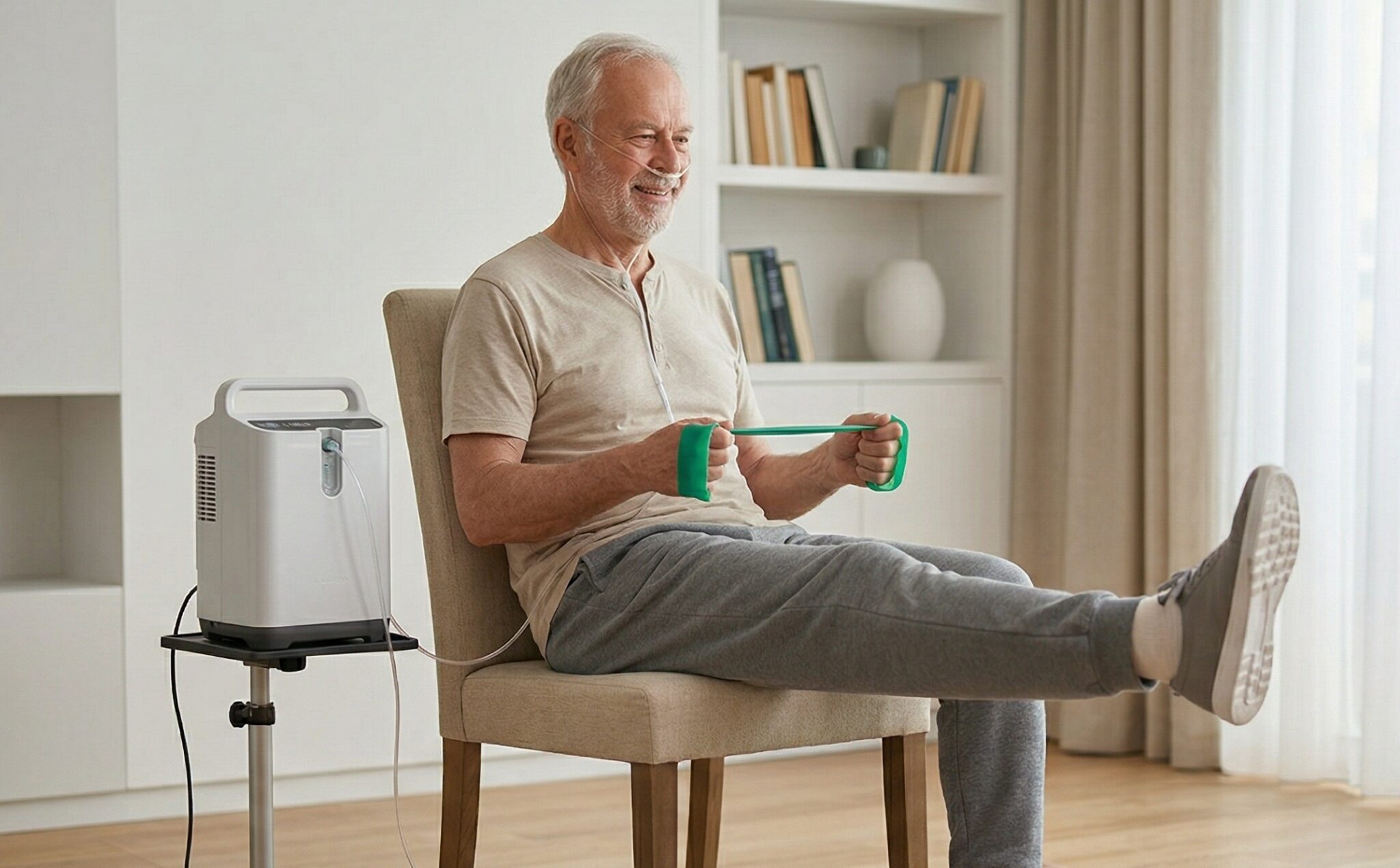
You don’t need to stand up to build muscle. In fact, for many on supplemental oxygen, seated exercises are the safest way to build “muscle efficiency.” When your muscles are stronger, they require less oxygen to perform tasks, which in turn reduces the strain on your lungs.
Top Seated Moves:
- Bicep Curls: Using 1–2 lb weights (or even soup cans), slowly lift toward your chest.
- Leg Extensions: While sitting, slowly straighten one leg out in front of you, hold for two seconds, and lower.
- Seated Marches: Lift your knees one at a time as if you are marching while sitting in a sturdy chair.
Real-Life Insight:
“I used to think ‘exercise’ meant sweating at a gym. My pulmonary rehab specialist taught me that lifting a 1-pound weight while sitting in my recliner counts. It sounds small, but after three months of seated weights, I can carry my own laundry basket again. My POC sits right next to the chair, and I never feel ‘pushed’ over the edge.” — Martha, 72
3. Pulmonary-Focused Yoga and Tai Chi
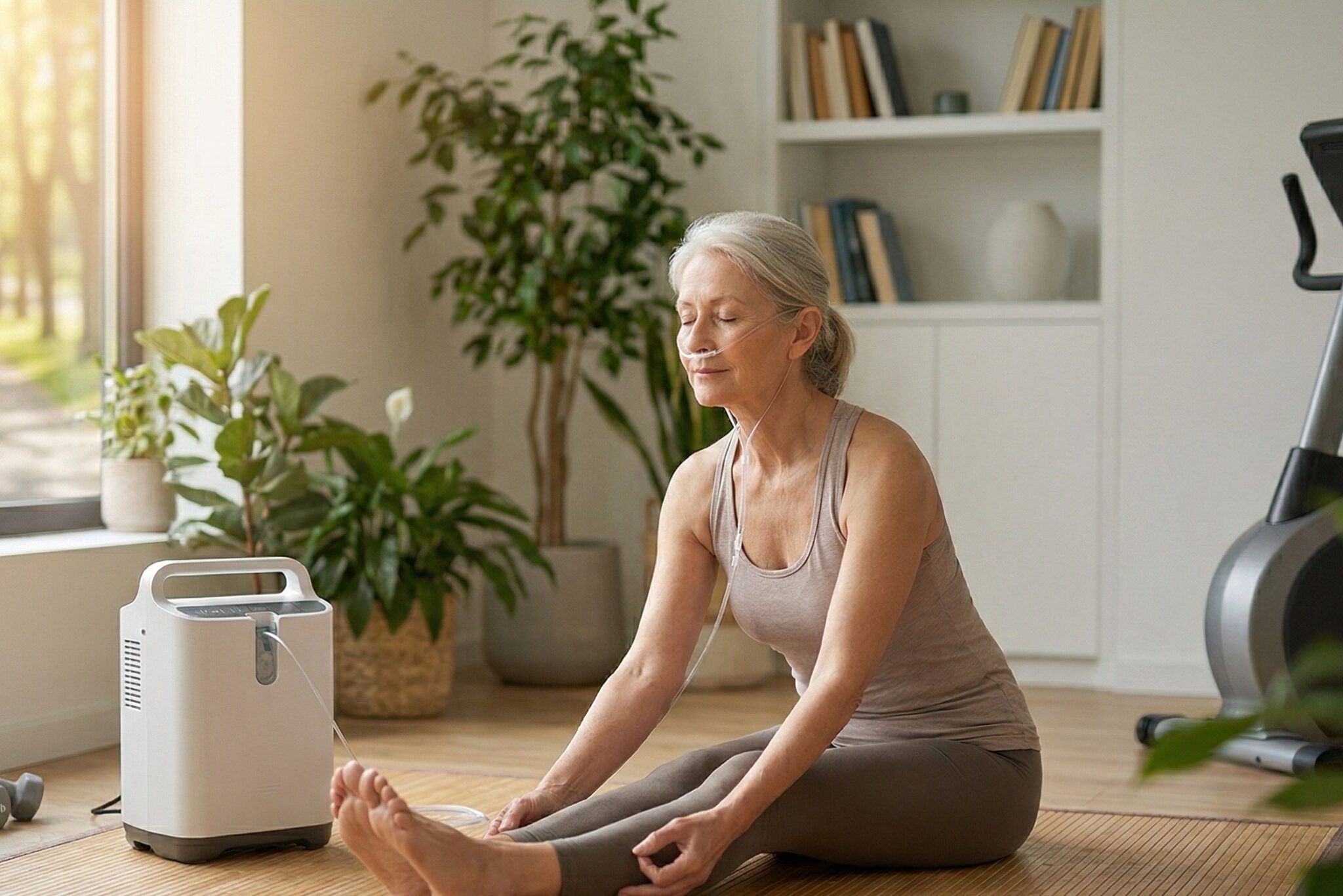
Yoga and Tai Chi are often misunderstood as “stretching.” For a POC user, they are actually breath-management systems. These disciplines focus on the synchronization of movement with the breath, which is the exact skill needed to manage supplemental oxygen.
Why it works:
Tai Chi involves slow, flowing movements that improve balance (crucial for those carrying the weight of a POC) and reduce the anxiety that often accompanies shortness of breath.
Yoga Poses to Try:
- The Mountain Pose: Standing tall (or sitting tall) and focusing on expanding the chest.
- Seated Forward Fold: Gently stretching the back to allow the posterior lobes of the lungs more room to expand.
Safety Note: Avoid “Inversions” (poses where your head is below your heart) as these can cause blood pressure spikes and make breathing more difficult for those with lung issues.
4. The Stationary or Recumbent Bike
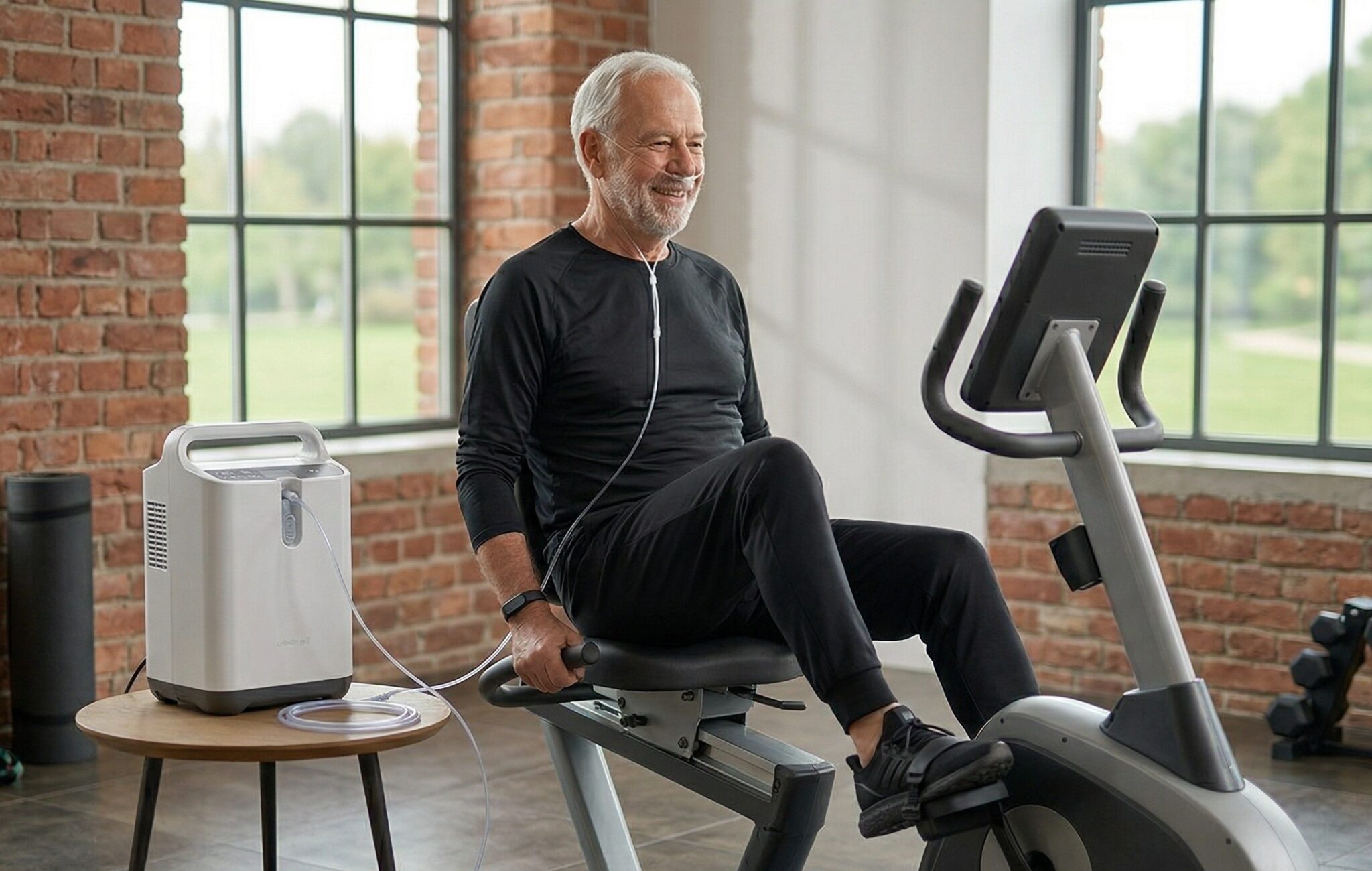
If balance is a concern or if your POC feels too heavy to carry while walking, a recumbent bike is your best friend. Because you are reclined, your diaphragm isn’t compressed, allowing for maximum lung expansion.
Pro-Tip for Equipment:
Place your POC on a small side table or a specialized stand next to the bike. Use a longer cannula tubing (7–10 feet) to ensure you have a full range of motion without the machine vibrating against the bike frame.
Real-Life Insight:
“I bought a used recumbent bike for $50. I set it up in front of the TV. I put my concentrator on the floor next to me, plug it into the wall to save battery, and ‘ride’ through a whole episode of Jeopardy. It’s the only time I feel like my old self—just moving my legs and getting the blood pumping.” — James, 65
Essential Safety Checklist for POC Users
Before you start any of the activities above, run through this 5-point safety check:
The Psychological “Win” of Staying Active
The most significant benefit of exercising with a POC isn’t actually your $O_2$ saturation—it’s your mental health. Chronic lung disease often leads to a “cycle of inactivity”: you feel short of breath, so you move less; moving less makes your muscles weak; weak muscles require more oxygen, which makes you even shorter of breath.
Breaking that cycle is an act of bravery.
Real-Life Insight:
“The day I stopped hiding my POC was the day I started living again. I took it to a Tai Chi class in the park. People didn’t stare with pity; they looked at me with respect because I was out there doing the work. My lungs might be damaged, but my spirit isn’t.” — Sarah, 61
5. A Starter 7-Day Low-Impact Exercise Schedule for POC Users
It can be daunting to figure out how to structure your new exercise routine. The goal is consistency over intensity. Use this weekly guide to get started.
Final Thoughts: Start Small, Stay Consistent
You don’t need to run a marathon. You don’t even need to walk a mile. You just need to move more today than you did yesterday. The POC is not a sign of “the end”—it is the tool that allows you to keep the engine running.
By choosing low-impact exercises like walking, seated weights, and yoga, you are telling your body that you are still in the game.