
In the landscape of 2026 respiratory care, the technology behind supplemental oxygen has reached a pinnacle of efficiency. However, for the end-user, the choice between a Portable Oxygen Concentrator (POC) and a Stationary Home Concentrator remains one of the most significant decisions in their treatment journey.
Choosing the wrong setup doesn’t just impact your wallet; it impacts your freedom, your sleep quality, and your physical activity levels. At Sleeprestfully, we see patients every day who struggle to balance the need for high-flow oxygen with the desire to remain active. This guide breaks down the “vitals” of both systems and includes real-life feedback from patients who have navigated these exact choices.
The Stationary Concentrator: The “Workhorse” of Home Therapy
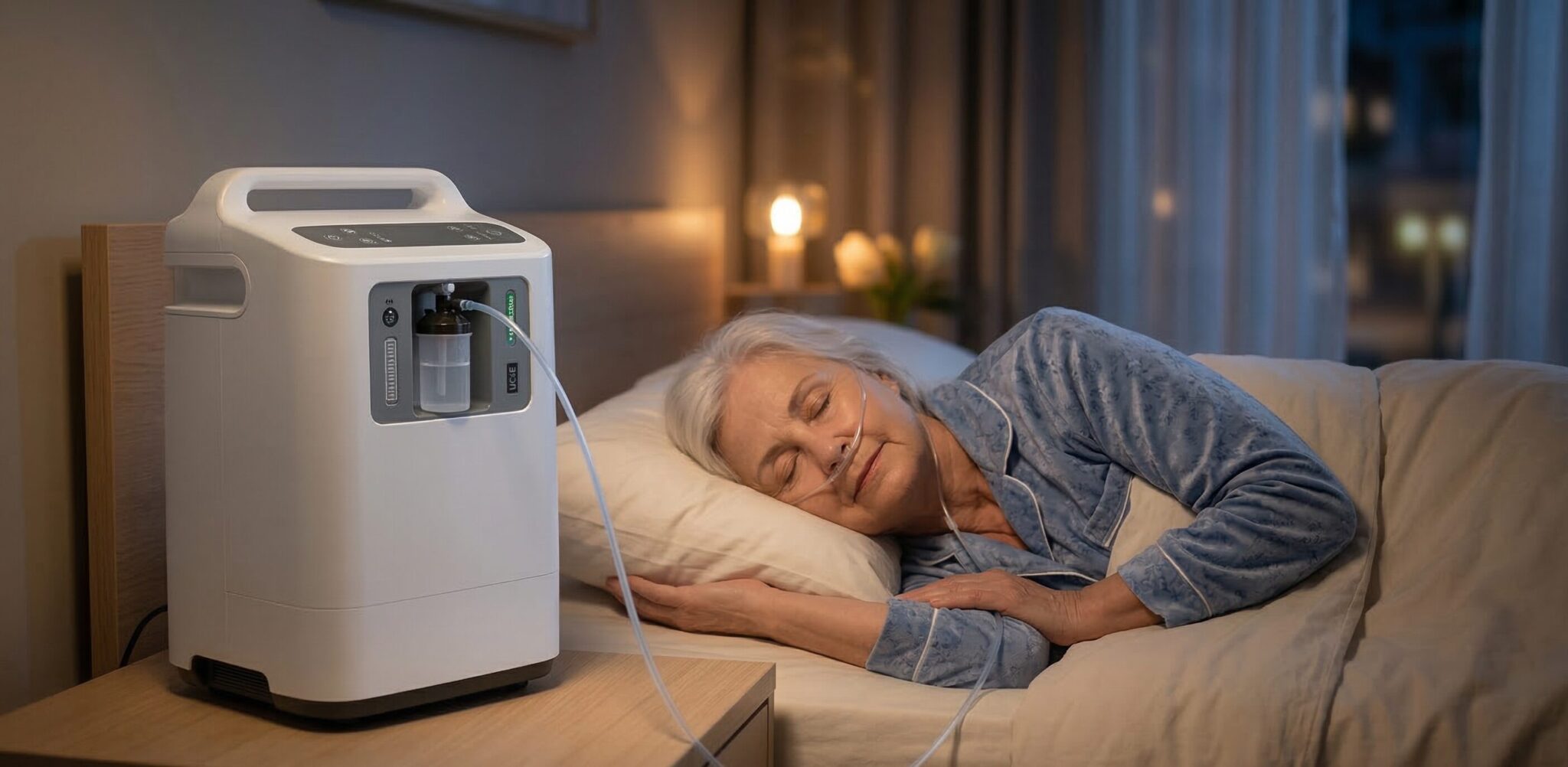
Stationary oxygen concentrators are designed for 24/7 reliability. Unlike their portable counterparts, these units are built to provide a Continuous Flow of oxygen, typically ranging from 1 to 10 Liters Per Minute (LPM).
The Technical Edge
Stationary units, such as the ResMed Mobi or the Invacare Platinum, utilize larger molecular sieve beds. This allows them to extract oxygen from the room air more vigorously, maintaining a consistent 93% (plus or minus 3%) purity even at high flow rates.
Pros:
- Uninterrupted Flow: Essential for patients who require oxygen while sleeping, as pulse-dose (portable) units may not trigger if your breathing becomes shallow during REM sleep.
- Low Maintenance: These units are built to run for thousands of hours with only basic filter cleaning.
- Humidification: Stationary units easily attach to humidifier bottles to prevent nasal dryness—a common complaint in long-term therapy.
Cons:
- Mobility: While they have wheels, they are tethered to a power outlet. You are limited by the length of your oxygen tubing (usually 50 feet).
- Noise and Heat: Because of the powerful compressors, these units generate more noise and ambient heat than portable versions.
Real-Life Feedback: > “I used to try and sleep with my portable unit to save on electricity, but I’d wake up gasping because the pulse didn’t catch my shallow breaths. Moving to a dedicated stationary unit at night changed everything. It’s a bit loud, like a humming refrigerator, but I haven’t had a ‘low-O2’ headache since.” > — Arthur S., 68, Chicago, IL
The Portable Oxygen Concentrator (POC): The Freedom Machine

The POC has revolutionized the 2026 lifestyle for oxygen users. These devices are lightweight, battery-operated, and designed to go anywhere—from the grocery store to a transatlantic flight.
The Technical Edge
Most POCs operate on Pulse Dose delivery. They utilize sensitive pressure sensors to detect the exact moment you begin to inhale, delivering a “bolus” (burst) of oxygen. This preserves battery life and allows the unit to be miniaturized.
Pros:
- True Independence: With modern lithium-ion batteries lasting up to 13 hours (on units like the Inogen One G5), you are no longer home-bound.
- Travel Ready: All POCs sold by Sleeprestfully are FAA-approved, allowing for seamless air travel.
- Lightweight: Modern units weigh as little as 3 to 5 lbs, making them easy to carry in a shoulder bag or backpack.
Cons:
- Limited Output: Most POCs cannot provide continuous flow. If your prescription requires a constant 3 LPM, a small pulse-dose POC may not meet your clinical needs during exertion.
- Battery Management: You must always be mindful of your charge levels, especially in 2026, where airlines enforce strict battery life margins.
Real-Life Feedback: > “I was hesitant to leave the house with my tanks, but the POC gave me my life back. I recently took my grandkids to the zoo. I just kept a spare battery in the bottom of the stroller. It’s small enough that people don’t even realize I’m on oxygen—they think it’s just a camera bag.” > — Elena R., 72, San Diego, CA
Head-to-Head: Which One Fits Your Life?
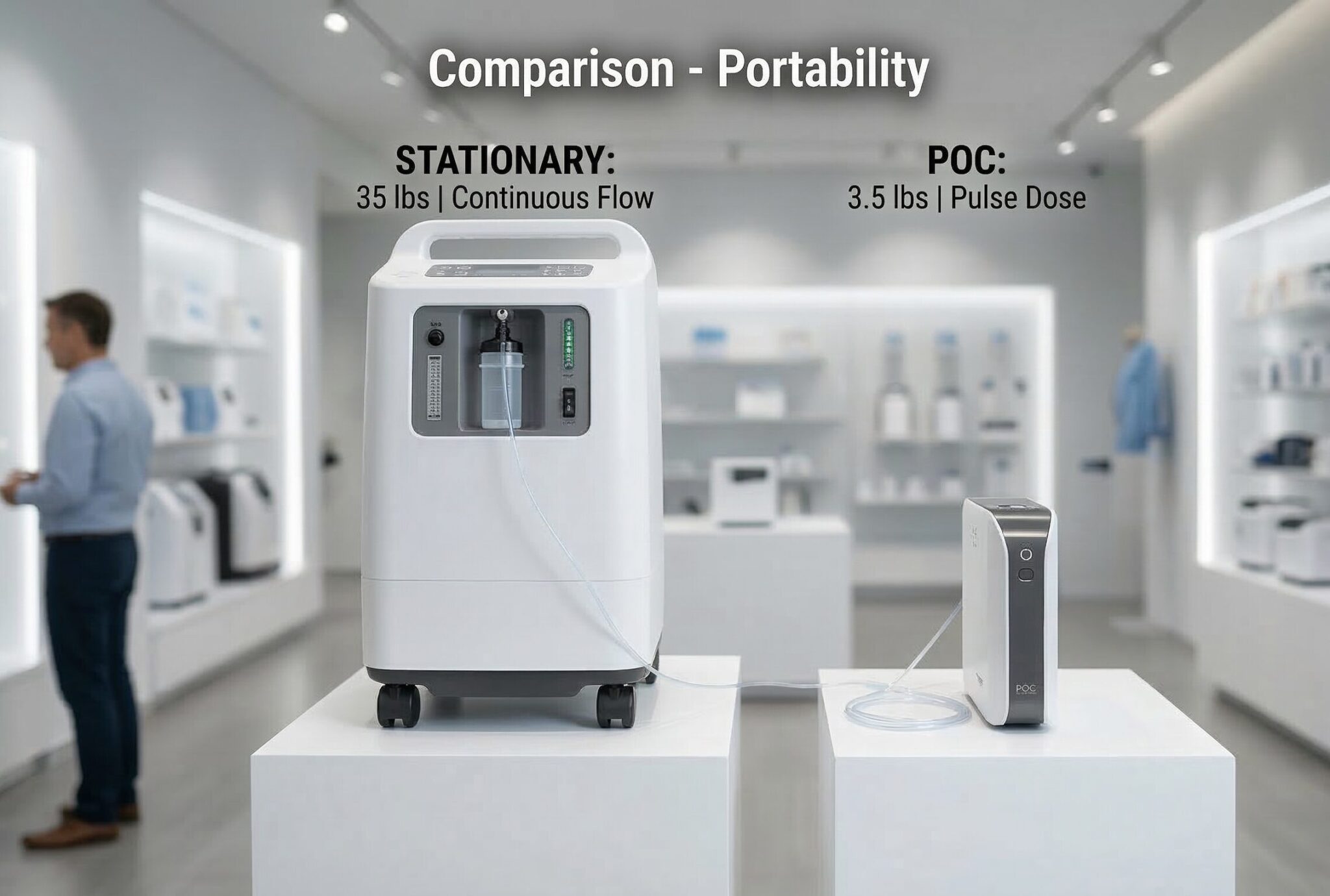
To help you decide, we have mapped out the most common 2026 lifestyle scenarios.
Scenario A: The “Homebody” or High-Flow Patient
If you spend 90% of your time at home and your prescription is 3 LPM or higher of continuous flow, the Stationary Concentrator is your primary tool. It provides the most cost-effective and reliable oxygen delivery for chronic conditions like advanced COPD.
Scenario B: The “Active Traveler”
If you are still working, traveling, or highly active in your community, a POC is non-negotiable. It allows you to maintain your social connections without the “tether” of a home unit.
Scenario C: The “Hybrid” Approach (The 2026 Standard)
The most common recommendation from Sleeprestfully experts in 2026 is the Dual-System.
- Stationary unit in the bedroom for safe, humidified sleep.
- POC for daytime errands, exercise, and social outings.
2026 Comparison Table
| Feature | Stationary Concentrator | Portable Concentrator (POC) |
| Primary Delivery | Continuous Flow | Pulse Dose (mostly) |
| Max Flow Rate | Up to 10 LPM | Up to Setting 6 (equiv. to 3 LPM) |
| Weight | 30 – 50 lbs | 3 – 10 lbs |
| Power Source | AC Wall Outlet | Internal/External Battery + AC/DC |
| Humidification | Built-in / Easy Attachment | Difficult / Not Recommended |
| Noise Level | 40-50 dB (Noticeable) | 37-43 dB (Quiet) |
Critical Factors to Discuss With Your Doctor
Before you buy, ensure you have the answers to these three questions:
- Do I need Continuous Flow at night? If yes, a small POC will not suffice for sleep.
- What is my “Exertion Flow”? Your oxygen needs may double when walking compared to sitting. Your POC must be able to keep up with your highest level of activity.
- What is my travel schedule? If you fly, you must ensure your POC has the battery capacity to meet the 150% flight duration rule (e.g., a 4-hour flight requires 6 hours of battery).
Real-Life Feedback: > “My biggest mistake was buying a POC online that only went up to a setting of 3. My doctor increased my prescription to 4 during exercise six months later, and my machine became useless. My advice? Always buy a machine with a slightly higher capacity than you currently need to ‘future-proof’ your health.” > — Mark V., 65, Houston, TX
Real life experiences
Category 1: The “Traveler” Experience
Patient: Robert M., 64 (Retired Sales Executive) Device: ResMed AirMini (CPAP) & Inogen One G5 (POC)
“In 2026, the ‘150% battery rule’ for flying is no joke. I recently flew from London to New York. The airline gate agent actually checked my battery watt-hours before letting me board. My advice? Don’t just buy the machine; buy the extra large battery pack. Having a POC that fits under the seat while providing 8 hours of pulse-dose oxygen made the 6-hour flight stress-free. At the hotel, I switched to my AirMini CPAP. It’s so quiet my wife forgot it was on.”
Category 2: The “High-Flow” Home User
Patient: Margaret D., 74 (Chronic COPD) Device: 10L Stationary Concentrator
“I spent years trying to ‘get by’ on a portable unit at home, but my oxygen levels kept dipping to 86% while I slept. My Sleeprestfully specialist explained that I needed Continuous Flow at night, which small portables just can’t do. Now, I have a 10L unit in my spare room with 50 feet of tubing. I can cook, watch TV, and sleep with a constant 4 liters of oxygen. My energy levels during the day are night and day compared to last year.”
Category 3: The “Active & Social” User
Patient: James L., 58 (Early-Onset Sleep Apnea & Respiratory Fatigue) Device: CAIRE FreeStyle Comfort (POC)
“I’m still working full-time, and I didn’t want to look ‘sick.’ The CAIRE unit is so sleek it looks like a high-end messenger bag. What I love is the AI breath detection. When I’m walking fast to a meeting, the machine senses my heavy breathing and increases the oxygen bolus automatically. I don’t have to fiddle with buttons. It’s the closest thing to having ‘normal’ lungs again.”
Category 4: The “Tech-Savvy” Remote Patient
Patient: Sofia V., 61 (Diagnosed via Home Sleep Test) Device: ResMed AirSense 11
“The best part about modern CPAP therapy is the Cloud Data. My doctor in a different state reviews my sleep stats every Monday. If my mask is leaking or my AHI (events per hour) goes up, he sends a message to my machine to adjust the pressure. I don’t have to drive to a clinic for a tune-up. It’s proactive healthcare. If you’re tech-shy, don’t be—the app makes it look like a game where you try to get a ‘100’ score every night.”
Category 5: The “Sensitivity” Patient (Focus on Comfort)
Patient: David K., 69 (Light Sleeper / Nasal Irritation) Device: Fisher & Paykel SleepStyle+
“I almost quit CPAP because of dry nose and the ‘suffocation’ feeling of high pressure. The SensAwake feature on the F&P machine is a lifesaver. It knows when I wake up at 3 AM to use the bathroom and instantly drops the pressure to a whisper. By the time I’m back in bed and drifting off, it slowly ramps back up. It’s the only reason I’ve stayed 100% compliant with my therapy for over a year.”
Conclusion: Making the Move
There is no “one-size-fits-all” in oxygen therapy. The Stationary Concentrator is your reliable foundation, while the POC is your ticket to the world. For most patients in 2026, having a hybrid setup offers the best quality of life, ensuring safety at night and freedom during the day.
At Sleeprestfully, our clinicians are ready to help you match your prescription with the latest 2026 technology. Whether you need the power of a 10L home unit or the portability of a 3lb POC, we ensure you breathe easy, wherever life takes you.