

Choosing the right medical oxygen equipment is one of the most critical decisions an oxygen-dependent patient or healthcare provider can make. The market for ambulatory oxygen therapy has evolved dramatically from heavy, safety-restricted compressed gas cylinders to highly intelligent, power-driven systems. At the absolute forefront of this innovation stand two brands with completely divergent design philosophies: Inogen and O2 Concepts (Oxlife).
While both engineering-grade Portable Oxygen Concentrators (POCs) utilize Pressure Swing Adsorption (PSA) technology to filter nitrogen out of ambient atmospheric air and deliver purified medical-grade oxygen, they serve entirely different patient lifestyles and physiological profiles. Inogen has masterfully dominated the ultra-lightweight, pulse-dose market with the Rove 6, prioritizing absolute minimalism and maximum travel freedom. Conversely, O2 Concepts has pioneered the heavy-duty, high-output, dual-mode category with the Oxlife Independence, prioritizing continuous-flow clinical reliability and intelligent fleet management data syncing.
Evaluating these two industry giants requires a deep dive into five core pillars: delivery mechanisms, physical design, battery management, intelligent software, and clinical alignment.
1. Oxygen Delivery: Pulse Dose vs. Continuous Flow
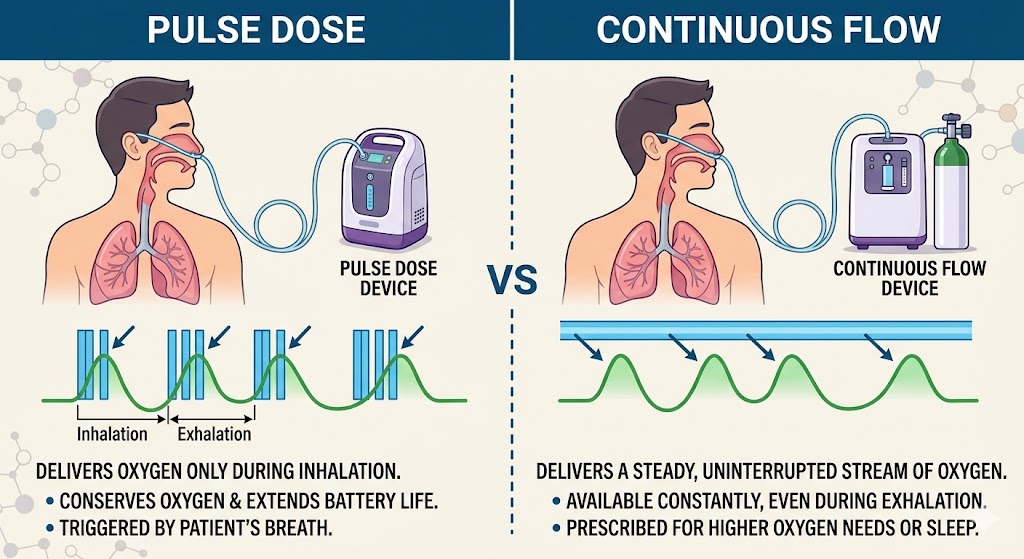
The definitive dividing line between the Inogen Rove 6 and the Oxlife Independence is how the purified oxygen gas travels out of the nasal cannula and into the user’s lungs.
[Inogen Rove 6]        ◄─── Pulse Dose Only ───► Ultra-Light, Breath-Triggered Bolus
[Oxlife Independence]  ◄─── Dual-Mode System ──► Continuous Flow + Pulse Dose Stability
Inogen Rove 6: Pulse Dose Only
The Inogen Rove 6 operates exclusively as a pulse-dose device. It relies on hyper-sensitive internal pressure sensors that monitor the patient’s breathing cycle. The moment the patient begins an inspiratory effort, the device opens a rapid valve to deliver a precise bolus (burst) of oxygen.
Because the flow pauses during exhalation, zero oxygen is wasted into the ambient air. Inogen’s patented technology dynamically adjusts the bolus size based on the patient’s respiration rate; if you exercise and your breath shortens, the device automatically shrinks the bolus but increases the frequency to keep the total volume of oxygen strictly consistent.
Oxlife Independence: Continuous Flow & Pulse
The Oxlife Independence addresses a far more demanding clinical requirement: Continuous Flow. A continuous-flow system delivers an uninterrupted, steady stream of oxygen measured in Liters Per Minute (LPM), regardless of whether the patient is inhaling, exhaling, or holding their breath. This is the exact mechanism found in heavy, stationary home concentrators.
The Oxlife Independence is a true dual-mode system. It offers continuous flow up to 3.0 LPM, but can instantly be toggled into a pulse-dose mode (settings 1 through 6) for when the patient wants to conserve power. For patients whose lungs require a constant column of gas pressure to avoid nocturnal desaturation (oxygen dipping during sleep), continuous flow is non-negotiable.
2. Physical Design, Portability, and Weight Class
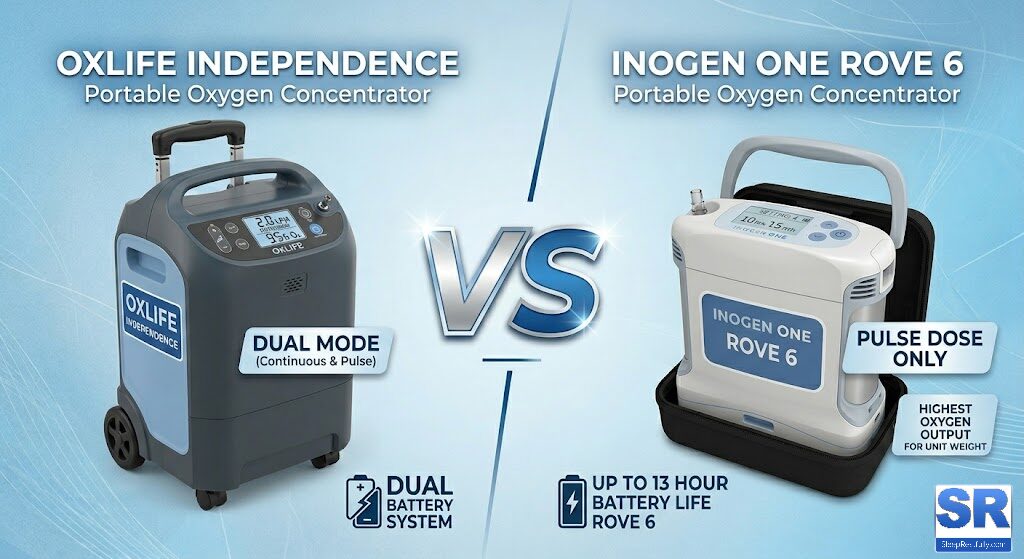
Because these devices utilize fundamentally different compressors to generate continuous versus pulsed flow, their physical dimensions and carrying styles fall into entirely separate weight classes.
| Metric / Feature | Inogen Rove 6 | Oxlife Independence |
|---|---|---|
| Weight | 4.7 lbs (with single battery) | 16.7 lbs (integrated cart) |
| Flow Type | Pulse Dose Only (Settings 1–6) | Dual-Mode: Continuous (1–3 LPM) & Pulse (1–6) |
| Primary Form Factor | Satchel / Shoulder Bag / Small Backpack | Heavy-Duty Luggage Style with Integrated Wheels |
| FAA Flight Approval | Approved | Approved |
Inogen Rove 6 Form Factor
At just 4.7 lbs, the Inogen Rove 6 feels akin to a compact camera bag or a light lunchbox. It can be worn effortlessly on a shoulder strap or configured into a sleek backpack, making it highly preferred for grocery shopping, walking, or running quick errands.
Oxlife Independence Form Factor
The Oxlife Independence is not meant to be slung over a shoulder. Weighing nearly 17 lbs, it utilizes a custom, built-in magnesium chassis fitted with rugged wheels and a long, telescoping luggage handle. It behaves like a highly maneuverable piece of carry-on luggage. While it demands more physical effort to hoist into a car trunk, its unique structural footprint allows patients who require high-flow oxygen to move freely through malls, airports, and parks.
3. Power Infrastructure and Battery Logistics
A portable oxygen concentrator is only as free as its battery runtime. Both brands approach power management through modular, rechargeable lithium-ion battery architecture, but their performance profiles vary drastically based on the flow load.
- Inogen Rove 6: Renowned for its industry-leading power efficiency. Because the internal compressor only spikes in activity during an inhalation trigger, the electrical draw is minimal. Equipped with an extended 16-cell battery, it can easily achieve up to 13 hours of runtime on a pulse setting of 1, and roughly 7 to 9 hours at a standard medical setting of 2 or 3.
- Oxlife Independence: Faces a far stiffer energy challenge. Running an oxygen compressor hard enough to sustain a continuous 3.0 LPM stream requires massive electrical currents. To combat this, it features a dual-battery slot system that allows for a hot-swappable exchange (replacing one battery while the machine runs on the other). On a pulse setting, it delivers a respectable 6 hours of use, but when cranked up to full continuous flow, that runtime drops sharply to between 1.5 and 2.5 hours.
4. Intelligent Telemetry and Fleet Technology
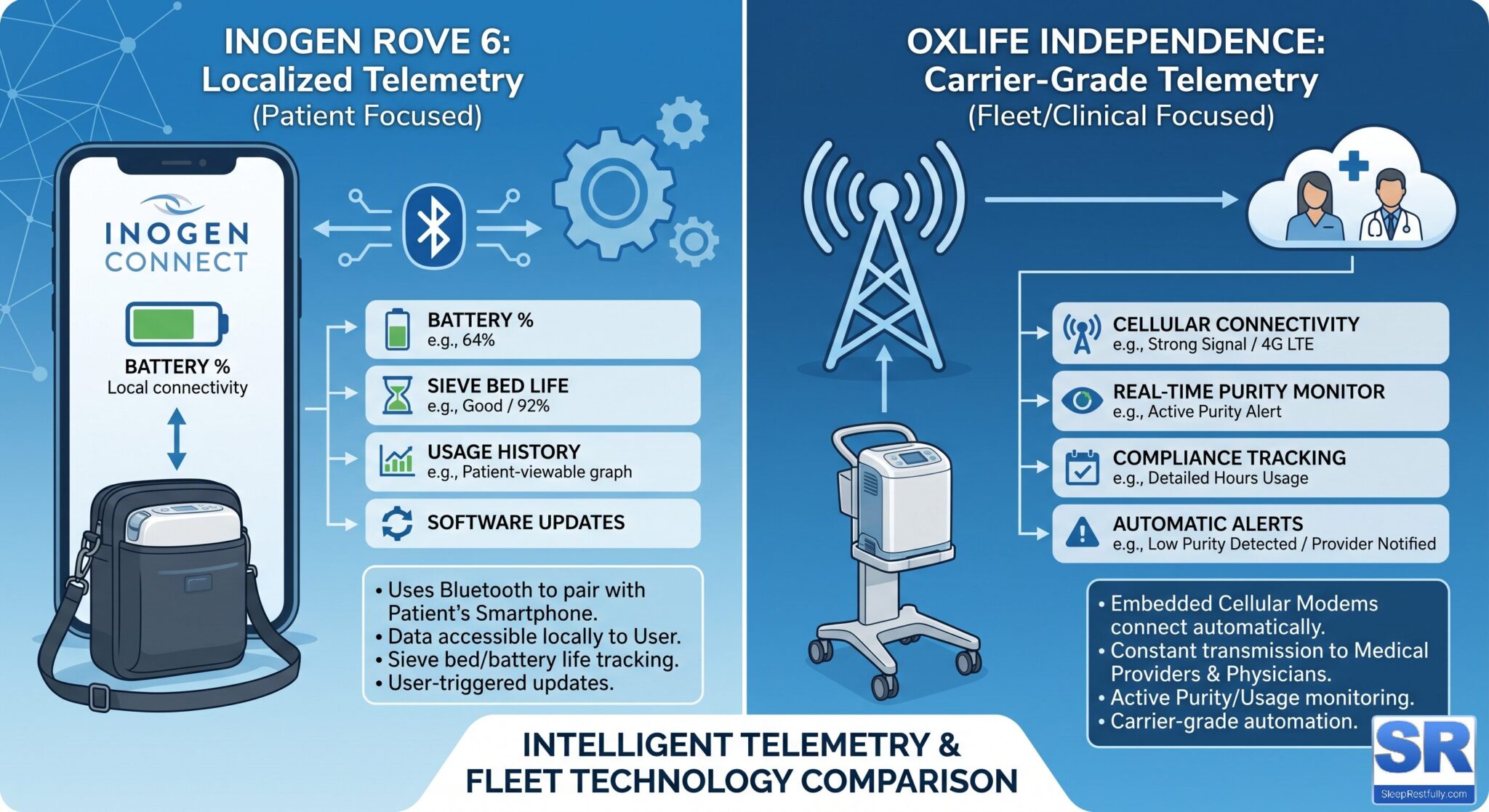
In the modern digital health ecosystem, a POC is no longer just a mechanical pump—it is a connected data node.
Oxlife’s DNA (Dynamic Network Analysis)
Oxlife devices lead the industry in carrier-grade automation. They are integrated with cellular modems that connect to local networks automatically, constantly transmitting real-time diagnostic and usage data directly to medical equipment providers and physicians. If the machine experiences a drop in purity or a blocked intake filter, it alerts the provider autonomously—often before the patient realizes there is an issue.
Inogen Connect
Inogen utilizes a consumer-focused, localized approach. Rather than relying on independent cellular networks, the Rove 6 uses Bluetooth to pair directly with a patient’s personal smartphone application. Through the app, the user can check exact battery life down to the percentage minute, track sieve bed life, and push software updates.
5. Clinical Target Mapping: Which System Matches Your Diagnosis?
Ultimately, choosing between the Inogen Rove 6 and the Oxlife Independence is not a matter of which machine is objectively “better,” but rather which machine aligns with a specific medical diagnosis and lifestyle expectation.
- The Case for the Inogen Rove 6: This machine is engineered for patients with mild-to-moderate chronic respiratory conditions—such as early-stage COPD, mild pulmonary fibrosis, or stable cardiac insufficiency—who maintain a robust inspiratory trigger. If you love to travel via commercial airlines, dine out regularly, and require a nimble, lightweight shield against exertional shortness of breath, the Rove 6 is the ideal companion.
- The Case for the Oxlife Independence: This machine is designed for patients with advanced, highly labile respiratory conditions. This includes advanced-stage COPD, severe interstitial lung disease (ILD), and neuromuscular disorders that weaken inhalation strength. Patients who suffer from severe nocturnal desaturation must use continuous flow at night, as mouth-breathing or shallow breathing during deep sleep frequently fails to trigger a pulse-dose machine. The Independence serves beautifully as an all-in-one system—acting as a highly stable continuous flow device on a nightstand by night, and transitioning into a rolling portable unit by day.
Final Review: Strategic Decision Matrix
- Choose the Inogen Rove 6 if your absolute priority is weight reduction, portability, and maximum battery lifespan. It is a tool designed to disappear onto your shoulder, giving you maximum physical ease during long walks and flights.
- Choose the Oxlife Independence if your priority is clinical versatility and constant gas delivery. It is a heavy-duty, highly advanced medical machine designed to guarantee an unwavering column of continuous oxygen under the most strenuous physiological conditions, backed by automated cellular health tracking.
You can get both devices at Sleeprestfully.com just give us a call!