Portable oxygen concentrators or POCs represent medical grade breathing devices aimed at patients with sleep apnea or other breathing-related conditions. Once, oxygen concentrators used to be heavy, difficult to use and they would allow minimum freedom of movement. Today, portable oxygen concentrators are small, compact and highly efficient devices equipped with heavy-duty batteries meant to provide patients with the most efficient treatment available whether at home or traveling.
There is a wide selection of POCs available on the market, but when choosing the perfect device, patients should make a well informed and educated decision. They should be able to select the perfect concentrator, suitable for their personal needs. Please find below a selection of the most popular, efficient and highly professional portable oxygen concentrators for 2026.
Things you should know about using a Portable Oxygen Concentrator (POC)
POCs allow users an incredible amount of flexibility and independence. With a portable oxygen concentrator you can enjoy your daily tasks at liberty while still getting the required amount of oxygen into your lungs. Portable Oxygen Concentrators are mainly ideal for people who lead an active lifestyle and wish to keep up with friends, family and conduct an active lifestyle outdoors as much as possible. With a POC it is also incredibly easy and convenient to travel.
However, it is important to keep in mind that POCs might require a higher investment. These therapeutic grade units come with complex technology and some truly complex features that allow users to move around and travel without any problems, while still getting required therapy. Depending on your individual needs, your lifestyle, your medical requirements, POCs come at various prices. It is also very important to carefully comparison shop and buy the concentrator that best suits your individual needs but also your available budget.
Things to consider before buying a POC
- Define your oxygen needs. How much oxygen do you need for sitting/standing, or for performing certain usual activities? Your physician can answer all these questions for you and then indicate the type of POC that you might need, based on your individual needs/lifestyle.
- How will you use your POC? Do you need the concentrator mostly while at home? Or do you need it mostly for traveling, exercising, etc. In case you wish to travel frequently, you will have to look for a concentrator that is FAA approved, and one that also comes with a compact and easy to carry design. Frequent travelers should look for a designated travel-friendly POC.
- Can you carry the POC, lift it easily? Or do you need one with a special carry bag? Check out carefully the carry options on the seller’s site and see which type of POC would best suit these needs.
- Would you need to use your POC mostly during daytime or during the night as well? This is an important question that can make a huge difference. If you need to use your POC on a 24 hours basis, you must select one that comes with all the required parameters and functions
- Do you need a continuous oxygen flow or a Pulse Dose? There are many POCs that provide both types of therapeutic functions and they can be alternated
- Do you need a POC with a humidifier function? Do you struggle often with irritations and allergies?
POCs: Frequently Asked Questions
What is the difference between Continuous Flow and PulseDose?
Both Continuous Flow and Pulse Dose represents the way in which the oxygen is delivered to the patient by the concentrator. Pulse Dose means that the oxygen is delivered to the patient only when the patient initiates a breath. A continuous flow means that the machine delivers oxygen on a constant level. It is important to mention that most available POCs with a Continuous Flow will also have the Pulse Dose option available.
Is it safe to use Pulse Dose setting during the night?
The majority of physicians will recommend the use of Continuous Flow while sleeping. However, you should ask your doctor for more details regarding whether or not you can use Pulse Dose setting during sleep.
Can you use your POC when traveling internationally?
Most portable oxygen concentrators will have an international power supply. You just need to use the compatible adapter for 100v, 250v / 50 or 60hertz respectively.
How about using your POC while traveling by car?
You can use your POC while traveling by car. You just need to use the DC adapter supplied with your machine. Replacement DC adapters are also available.
How much does a portable oxygen concentrator cost?
Prices may vary depending on several factors such as brand, POC type, extra functions, batteries and other aspects. POCs can start at around $1400 and go up to $3,500 or more.
Rove 6 Portable Oxygen Concentrator
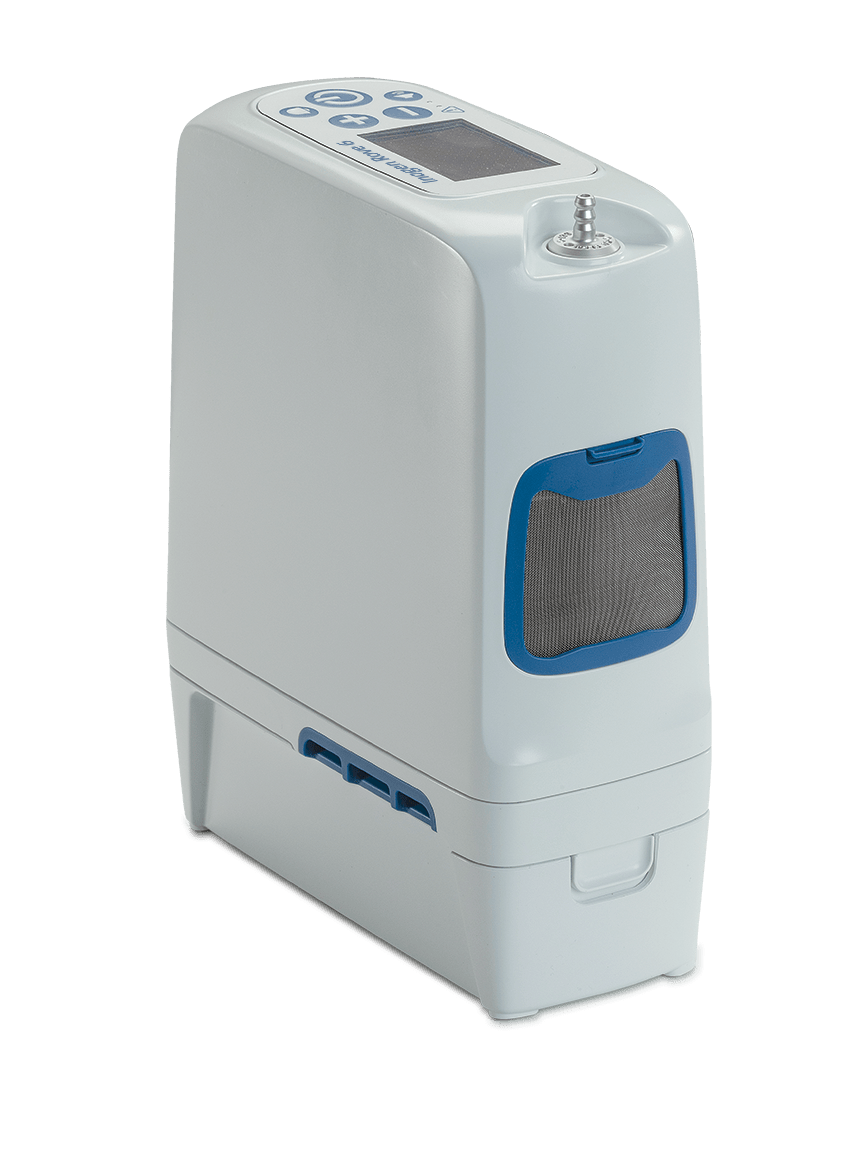
As we move through 2026, the Inogen Rove 6 has solidified its position as the premier choice for oxygen users who prioritize an active, mobile lifestyle. Succeeding the legendary Inogen One G5, the Rove 6 isn’t just a minor update; it is a refined medical device designed to withstand the rigors of daily travel while offering the highest oxygen output in its weight class. For those who found previous portable concentrators cumbersome or clinically insufficient, the Rove 6 offers a compelling argument for leaving the heavy tanks at home.
Engineering and Portability
The first thing one notices about the Rove 6 is its sleek, non-medical aesthetic. It looks more like a high-end camera bag than a life-support device. Its physical footprint is remarkably small, measuring 7.18″ Long x 3.27″ Wide x 8.14″ High when equipped with the standard battery. At a weight of just 4.8 lbs, it is light enough to be worn over the shoulder for hours during a museum visit or a walk through the park. Even with the extended 16-cell battery, which increases the weight to 5.8 lbs, the unit remains significantly more portable than most dual-flow competitors.
Clinical Performance and “Intelligent Delivery”
What truly sets the Rove 6 apart is its clinical reach. While many small units struggle to support users with higher oxygen needs, the Rove 6 offers six pulse flow settings, delivering up to 1,260 mL/min of medical-grade oxygen. This range is critical for patients whose needs might increase during physical exertion or as their condition progresses.
The device utilizes Inogen’s proprietary Intelligent Delivery Technology. This system is highly sensitive to the user’s breathing patterns; it detects the onset of inhalation and delivers the oxygen bolus within the first few milliseconds to ensure maximum absorption in the lungs. Furthermore, it automatically adjusts the bolus size based on your respiration rate. If you are sleeping and your breathing slows, the machine delivers a larger burst of oxygen to ensure you receive your required minute volume.
Operational Excellence
In terms of daily use, the Rove 6 is one of the quietest machines on the market. At just 37–39 dBA (roughly the sound of a quiet conversation), it can be used in theaters, restaurants, or places of worship without drawing unwanted attention. The user interface has been modernized with high-contrast blue buttons and a bright LCD screen, making it much easier to operate for those with visual impairments or in low-light conditions.
The battery performance remains the benchmark for the industry. With the standard 8-cell battery, users can expect up to 6 hours and 15 minutes of use. Those planning longer trips can opt for the 16-cell battery, which extends the runtime to an incredible 12 hours and 45 minutes on setting 1. This longevity, combined with full FAA approval for commercial flights, makes the Rove 6 the definitive travel companion.
Connectivity and Longevity
Inogen has also embraced the digital age with the Inogen Connect app. By pairing the Rove 6 with a smartphone via Bluetooth, users can monitor their battery life in real-time, track oxygen purity, and check the status of their sieve beds. Speaking of sieve beds, the Rove 6 is designed for longevity, with an expected service life of up to 8 years and user-replaceable columns that can be swapped out at home, avoiding the need for costly factory servicing.
Ultimately, the Inogen Rove 6 represents a peak in portable oxygen engineering. It successfully bridges the gap between “ultra-lightweight” and “high performance,” providing a reliable, quiet, and long-lasting solution that allows users to reclaim their freedom without compromising their clinical care.
ZEN-O Portable Oxygen Concentrator
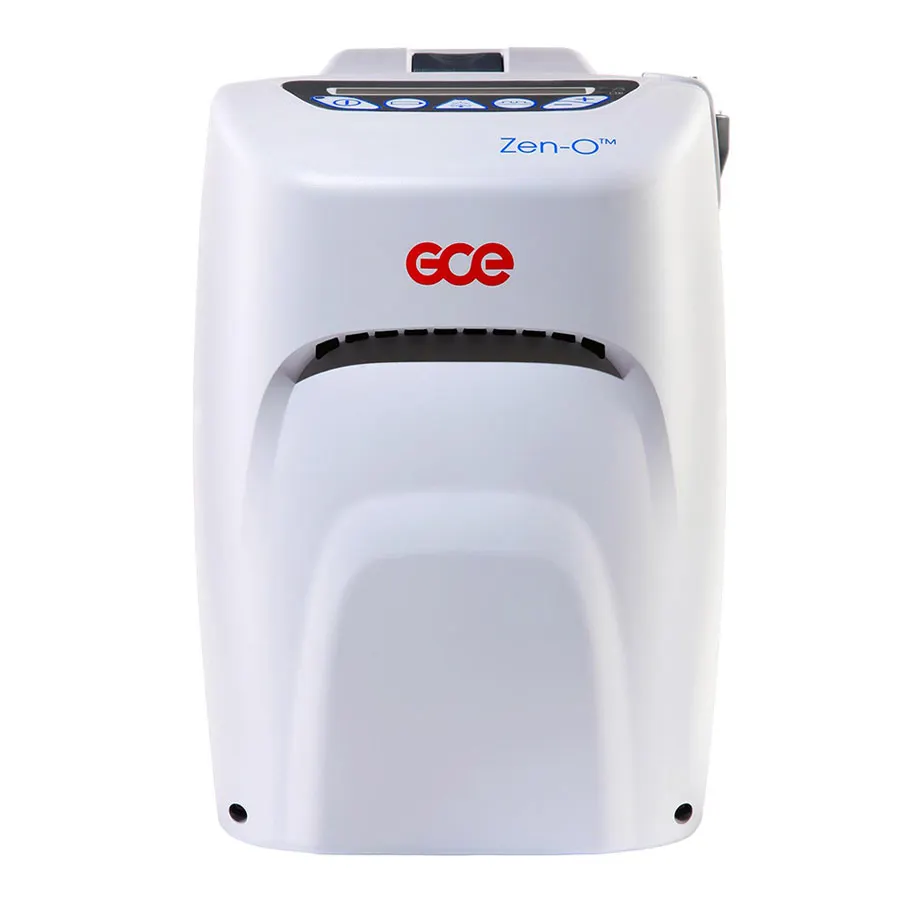
While the industry often chases the “smallest and lightest” titles, the GCE Zen-O carves out a vital niche by prioritizing clinical versatility over pocket-sized dimensions. Released as a robust “transportable” solution, the Zen-O is one of the rare devices that bridges the gap between lightweight pulse-dose units and heavy stationary concentrators, offering both pulse and continuous flow modes.
Size and Portability
The Zen-O is a mid-sized unit that feels substantial and durable. It isn’t a device you’ll forget is on your shoulder, but it is remarkably manageable for a machine with its power profile.
- Dimensions: 8.3″ Wide x 6.6″ Deep x 12.3″ High.
- Weight: It weighs 10.25 lbs with a single 12-cell battery. If you add a second battery for extended use, the weight increases to approximately 11.45 lbs.
Because of this weight, GCE includes a sturdy pull cart with every unit. The cart features large, rugged wheels and a telescopic handle, making it easy to navigate through airports or grocery stores without straining your back.
Performance: The “Dual Flow” Advantage
The Zen-O’s primary selling point is its ability to deliver oxygen in two distinct ways:
- Pulse Mode: Offers settings from 1.0 to 6.0 (adjustable in 0.5 increments).
- Continuous Flow: Delivers 0.5 to 2.0 Liters Per Minute (LPM).
This dual functionality is a game-changer for patients who need pulse dose during the day but require continuous flow at night—especially those who use a CPAP or BiPAP machine. Instead of traveling with two different devices, the Zen-O serves as an all-in-one solution.
Furthermore, it features Rate Responsive Therapy (RRT). This technology detects your breath rate and automatically adjusts the oxygen bolus to ensure you stay saturated during periods of increased activity, such as walking or climbing stairs.
Battery Life and Maintenance
The Zen-O can hold two batteries simultaneously, allowing you to swap them out without turning the machine off.
- On Pulse Setting 2: You can expect up to 4 hours with one battery or 8 hours with two.
- On Continuous Flow (2 LPM): The battery life drops significantly to about 45 minutes per battery, reflecting the high energy demand of continuous delivery.
Maintenance is refreshingly simple. It features field-replaceable sieve beds, meaning when the internal filters wear out, you (or a provider) can swap them in minutes without shipping the whole unit back to a repair center.
The Zen-O is the “Swiss Army Knife” of portable concentrators. It is the best choice for users with high oxygen demands or those who need a single device for both day and night use.
P2 Portable Oxygen Concentrator by Rhythm Healthcare
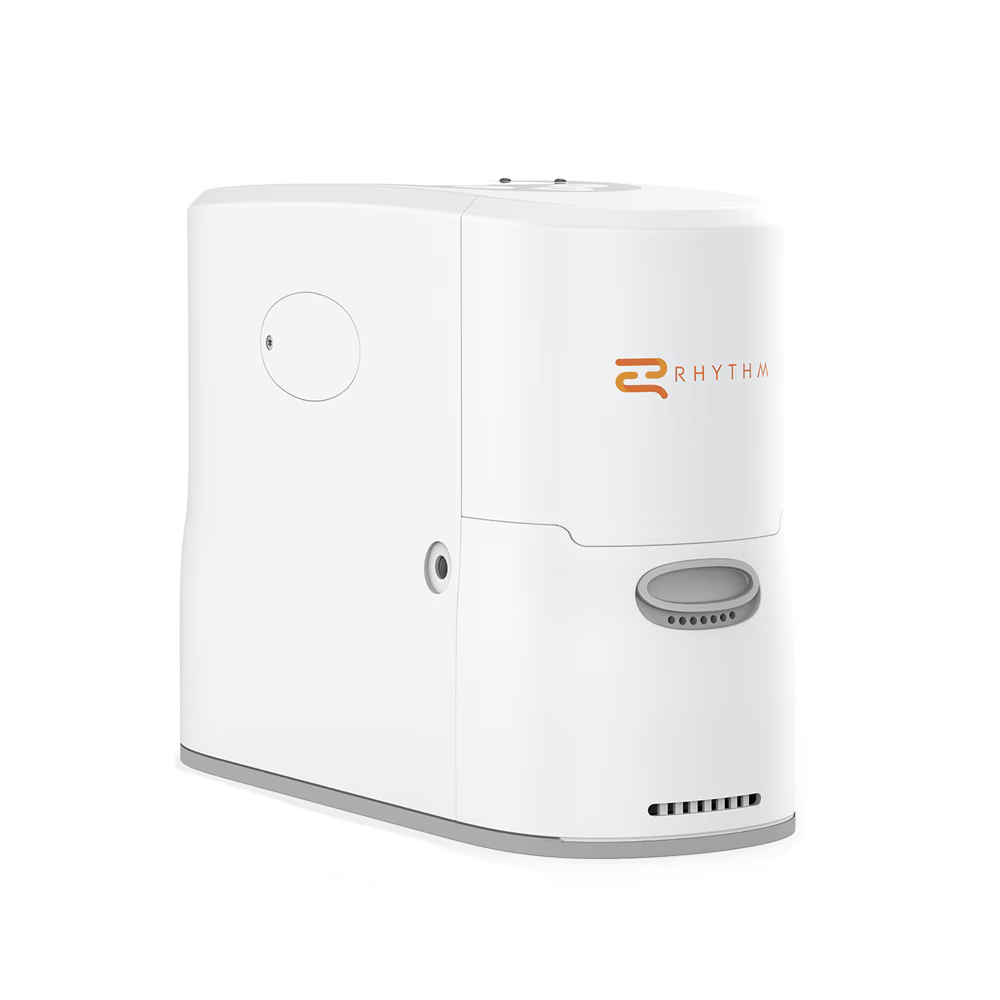
In the world of portable oxygen concentrators (POCs), the Rhythm Healthcare P2 is frequently cited as one of the most compact and user-friendly devices available in 2026. While brands like Inogen dominate the headlines, the P2 has earned a loyal following by offering a high-performance, pulse-dose solution that prioritizes a “forget-you’re-wearing-it” design.
Dimensions and Build Quality
The P2 is engineered for the minimalist. It is significantly smaller than many “standard” portable units, fitting comfortably in a small crossbody bag or even a large coat pocket.
- Dimensions: 8.7″ Long x 3.3″ Wide x 6.3″ High.
- Weight: It weighs a mere 4.37 lbs with the battery included.
Despite its light weight, the build feels sturdy. It features an high-absorption sieve bed and excellent heat dissipation, which are critical for a device this small to maintain high oxygen purity levels (typically 87% to 96%) without overheating during extended use.
Performance and Flow Settings
The P2 punches above its weight class by offering five pulse flow settings. Many ultra-lightweight units cap their output at setting 3 or 4, but the P2 provides a maximum oxygen output of 1,000 mL/min. This extra headroom makes it a viable option for users who have moderate-to-high oxygen requirements during physical activity.
One of its smartest features is the Intelligent Pulse Delivery. The device is highly sensitive to the user’s breath, ensuring the oxygen bolus is delivered at the very beginning of the inhalation for maximum absorption. If the device fails to detect a breath for 15 seconds, it triggers an “Auto-Pulse” safety mode to ensure continued delivery.
Battery Life and Charging
For a device under 5 lbs, the battery performance is competitive:
- Setting 1: Up to 5 hours.
- Setting 2: Up to 4 hours.
- Setting 5: Approximately 1 hour and 50 minutes.
The P2 is designed for the traveler; it is FAA-approved and comes with both AC and DC (car) adapters. A full charge takes roughly 4 hours, but the ability to swap batteries quickly makes it suitable for long days out or regional flights.
The Rhythm Healthcare P2 is the perfect “daily driver” for the active oxygen user. It lacks the bulk of its competitors without sacrificing the power needed for a brisk walk or a day of travel.
SeQual Eclipse 5
Eclipse 5 portable oxygen concentrator brought to you by SeQual is an innovative, highly reliable and efficient device. The device is capable of delivering both Pulse Dose and Continuous Flow therapy. Patients that require highly specific oxygen dosage will find the device very useful, as it can deliver continuous flow in 0.5 increments. There are also 6 different Pulse Dose settings available, from 16 to 192ml. SeQual Eclipse 5 weighs only 18.4lbs with battery included, and it has the following dimensions: 12.3 in wide and 7.1 in deep. Even though this is not a lightweight portable oxygen concentrator, patients can carry it around effortlessly thanks to the efficient cart that is included in the purchase. The cart is equipped with a telescopic handle so that you can adjust it exactly the way you want, and you can easily fold up the cart for better transportation.
- Adjustable Rise Time and Bolus Size – with autoSAT technology for maintaining the optimum oxygen levels
- Continuous Flow setting from 0.5 to 3LPM
- Pulse Dose setting from 16 to 192ML
- Easy battery recharge using the standard DC supply
- Both flow settings are available while the device charges at the DC power
- Plenty of alarms and alerts available: low battery, Oxygen flow outside normal levels, unit malfunction, unit power loss, no inspiration detectable in pulse dose mode, low oxygen output
- Battery duration at Continuous Flow setting is 2 hours at 2LPM and 5.1 hours in Pulse Dose mode
- FAA approved portable oxygen concentrator
Product Specifications
- AutoSAT Technology- helps maintaining a steady oxygen level + Adjustable Rise Time & Bolus Size
- 0.5L to 3LPM Continuous Flow
- 16 to 192mL Pulse Dose Mode
- Battery rechargeable while the main unit is connected
- Rise Time options: Slow, Medium, Fast
- 3 Adjustable Pulse Dose sensitivity settings
- Dimensions: 12.3 inches Wide x 7.1 inches Long and 19.3 inches high
- Weight: 15 pounds (18.4 pounds including battery)
- 3 years Manufacturer’s warranty
- Several alarms: low battery, unit malfunctioning, low oxygen flow, no breath detected
- Battery charging times: 1.8 hours and up to 5 hours in order to reach 80% capacity
- FAA Approved unit
- Noise levels: 48 dB at 3LPM / 40dB at 3.0 Pulse Dose setting
Price Comparison Chart
| Model | Flow Type | Weight | Max Setting | Est. 2026 Price | Best For |
|---|---|---|---|---|---|
| Rhythm P2 | Pulse Only | 4.37 lbs | Pulse 1-5 | $1,800 – $2,200 | Maximum Portability & Value |
| Inogen Rove 6 | Pulse Only | 4.8 lbs | Pulse 1-6 | $2,995 – $3,295 | Long Battery & Quietness |
| GCE Zen-O | Pulse + Continuous | 10.25 lbs | 2.0 LPM / Pulse 6 | $2,285 – $3,145 | Day/Night Versatility |
| SeQual Eclipse 5 | Pulse + Continuous | 18.4 lbs | 3.0 LPM / Pulse 9 | $3,200 – $3,800 | High Oxygen Requirements |
When buying POCs online, it is extremely important to choose a reputable seller. This way you can rest assured that you will enjoy the best possible price, with flexible financing options available and seller warranties. Online, you can also compare prices and features in order to select the POC that best suits your individual needs. By choosing a reputable seller you can also ask questions or state your concerns.
When shopping online, you can narrow your search considering the following criteria:
- Selecting a POC with the best battery duration, especially if you lead an active lifestyle
- Size- look for a small and compact portable oxygen concentrator that suits your needs and individual lifestyle
- Weight- look for a light POC that can be easily carried around- especially if you are a frequent traveler
- Search for an FAA approved POC that will allow you to take therapy with you even during flights
If you have any experience with these machines and want to share your opinion please do it in the comment section below. To find out what are the oxygen concetrator prices click on the links above the pictures.
Charles Goldberg
Hello Thommy,
Thank you for your comment. We will include one of their products as soon as we get our hands on a review unit.
Best Regards
Thommy
You’ve NOT mentioned OxyGo portable oxygen concentrators. WHY?.
Charles Goldberg
We do not accept any third party insurance. We accept all major credit cards.
Richard White
Do you except medical Medicare
Charles Goldberg
The Inogen One G5 is a pulse dose unit only. We do have units that will do both. A suggestion would be the Philips Respironics SimplyGo.